

FRC-566-001 · v2.2
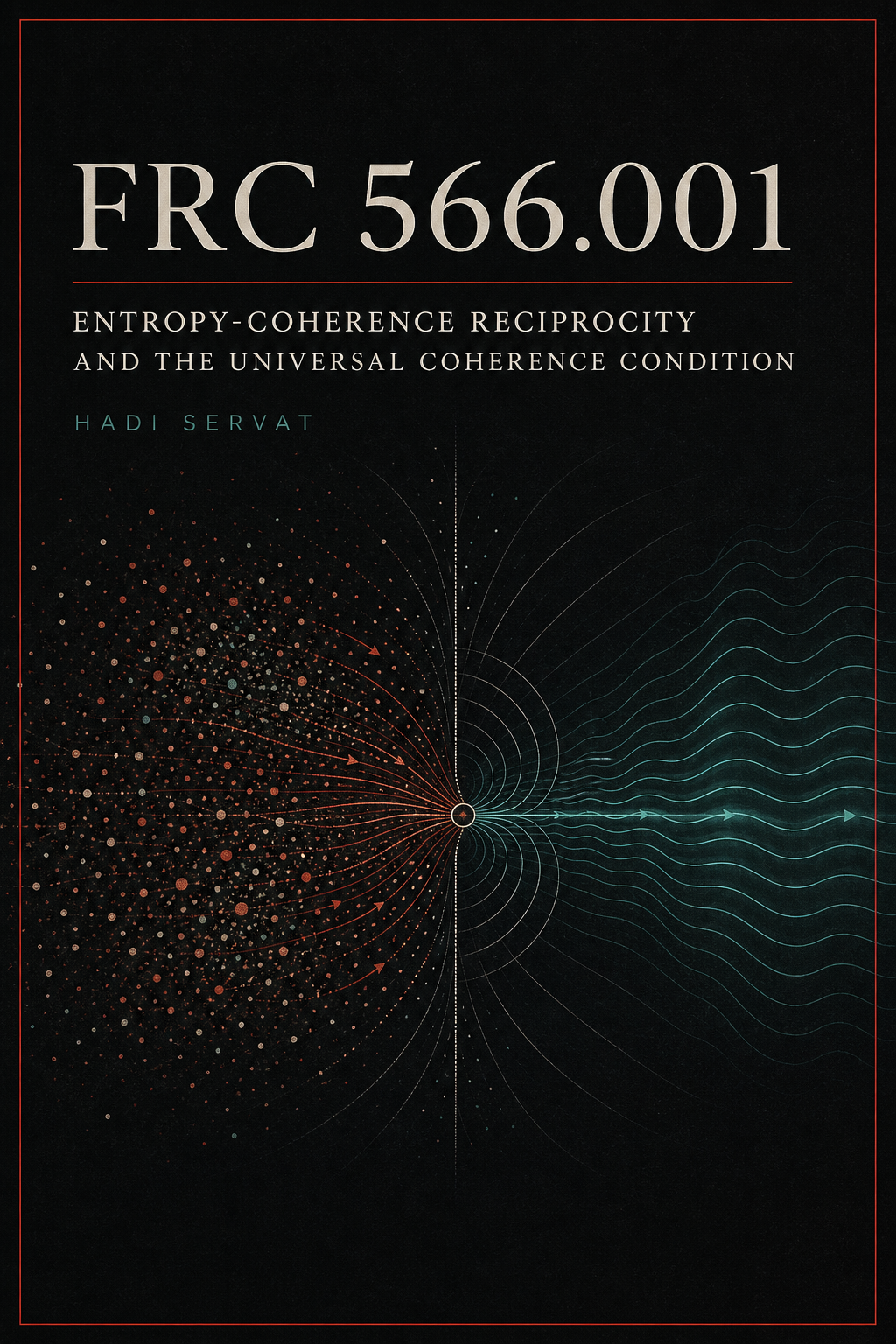
Entropy-Coherence Reciprocity and the Universal Coherence Condition v2.2
Reading status
Current statement
The canonical 566 law remains dS + k* d ln C = 0. Indexed notation belongs to operational realizations; residuals diagnose a declared boundary and do not replace the law.
Evidence level
Living core preprint
preprint
Declared μ register
μ1 · Physical / atomic
Atoms, fields, quantum systems, thermodynamics, and other physical observables.
Open boundary
The universal physical extension remains conjectural beyond declared bookkeeping.
Version lineage
Supersedes: FRC 566.001 v2.1
On this page
FRC 566.001 states entropy-coherence reciprocity in its canonical scale-invariant form dS + k* d ln C = 0. The starred Boltzmann bridge k* is not an ordinary tunable constant and is never fitted to an outcome or evolving state. Experiments and computations instantiate the same law at a declared register mu as dS_mu + k*_mu d ln C_mu = 0, with explicit entropy channel, coherence channel, units, and boundary. FRC uses the relation operationally as bookkeeping and proposes its open-system physical extension as a conjecture. Standard entropy production remains non-negative, but no toy closure is promoted into a universal directional replacement. The exact von Mises calculation and the Langevin boundary probe remain scoped results. The corrected information projection is retained: C[q]/C[p] depends on the entropy difference, not generally on D_KL(p||q), and C_XY = C_X C_Y exp(+I/k*).
Linked from
- Fractal Resonance Coherence: A Framework for Complex Systems Analysis
- Quantum Foundations in the FRC Framework
- Born-Rule Deviations under Finite-Time and Non-Equilibrium Conditions
- UCC PDE: Existence, Uniqueness, and Dissipation
- Spectral Modes and Relaxation in UCC
- Foundational Questions in Fractal Resonance Coherence
- FRC 840.001 — The Λ-Tensor Model: Beyond the Transformer Paradigm
- 'FRC 16D.001 — The Universal Vector: A Standardized Protocol for Stateful Human-AI
- Resonant Computing: Coherence Processing Units and Non-Boolean Logic
- FRC 840.101: The Phase–Attention Boundary
- FRC 100.000 v1.2 - Start Here: Canonical Stance and Version-Aware Reading Map
- FRC 100.009 v2.6: Operational Local Reciprocity Dynamics
- FRC 100.011 v1.2 - Translation Table: FRC Vocabulary and Claim Status
- FRC 700.777 v1.0 - μ Registers: A Nested Scope Model for Scale-Declared Reciprocity
- The Reflexive Threshold: Corpus Integration, Witness, and Claim-Graph Audit v0.1
- The FRC Threshold Handbook: A Standalone Onboarding and Application Protocol v0.1
- Coherence (C)
- Consciousness (FRC perspective)
- What is Time?
- Universal Coherence Condition (UCC)