FRC.v2 — fractalresonance.com

Fractal Resonance Cognition: A Framework for Complex Systems Analysis

Hadi Servat2025-03-23FRC 100
frameworkcomplex-systemsquantum-chaosfractal-resonanceoperator-formalism
Introduces Fractal Resonance Cognition (FRC), a theoretical framework for analyzing complex systems across quantum physics, biology, and cosmology. FRC proposes that complex systems are governed by vortex-like attractor structures with fractal scaling and resonant dynamics.

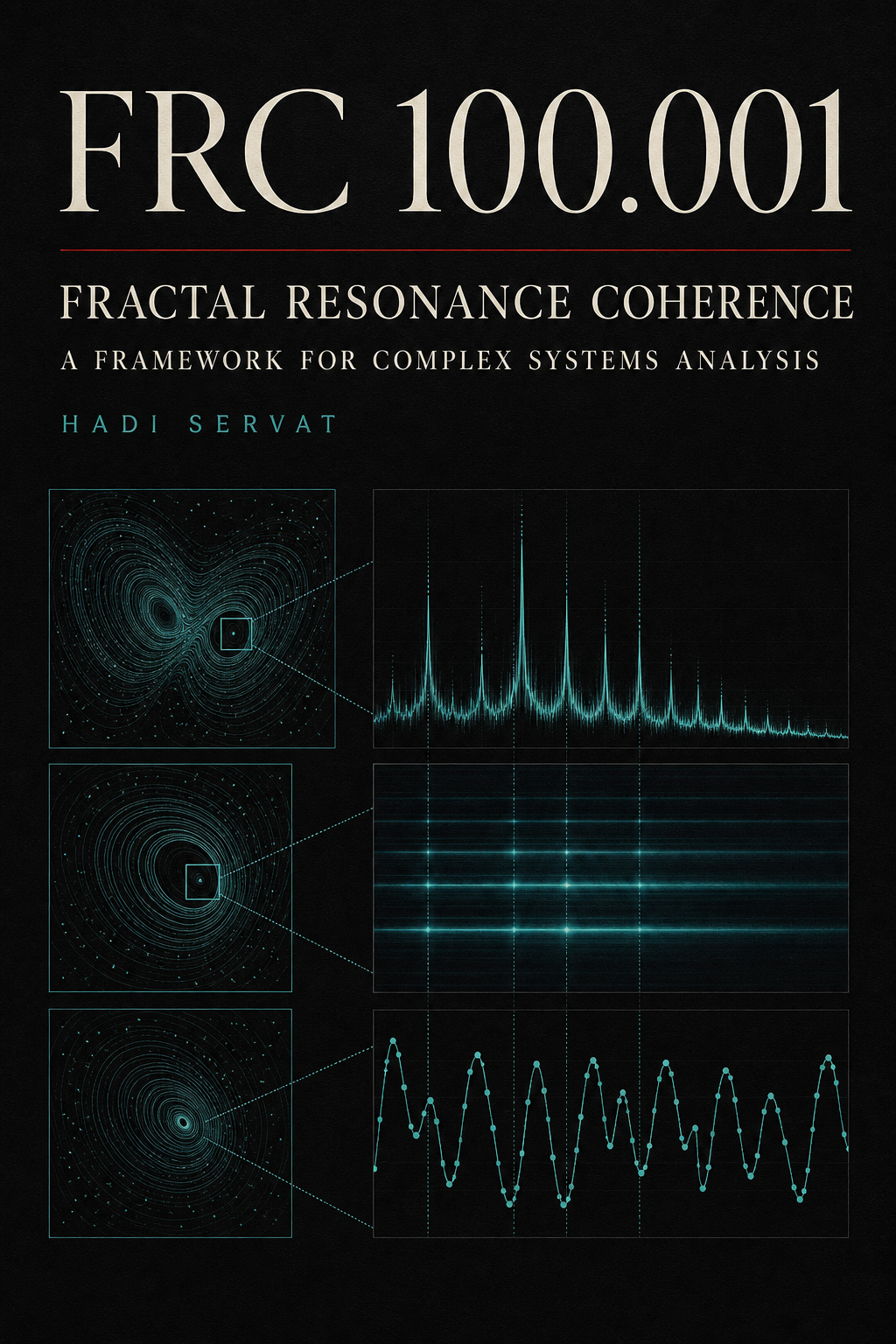
FRC 100.001 — Fractal Resonance Cognition: A Framework for Complex Systems Analysis

1. Introduction

Complex systems—ranging from quantum chaotic systems to biological networks and cosmological structures—often exhibit behaviors that appear random or unpredictable. Traditional approaches, such as random matrix theory (RMT) in quantum physics or statistical mechanics in thermodynamics, rely on stochastic models to describe emergent phenomena. While effective, these models frequently overlook the possibility that apparent randomness may stem from deterministic, structured dynamics operating at fractal scales.

We propose Fractal Resonance Cognition (FRC), a novel theoretical framework that reinterprets complexity through the lens of self-similar, resonant dynamics. FRC posits that complex systems are governed by vortex-like attractor structures exhibiting fractal scaling, which manifest as resonant patterns in spatial, spectral, or temporal domains.

The core hypothesis of FRC is that fractal resonance—deterministic interactions between self-similar structures—serves as a fundamental organizing principle across scales and disciplines.

1.1 The Role of "Cognition" in FRC

The term "Cognition" in Fractal Resonance Cognition is used metaphorically to describe the complex information processing inherent in systems exhibiting fractal resonance. Just as cognitive systems process information through interconnected, hierarchical structures, FRC proposes that complex systems process "information" via self-similar, resonant dynamics.

2. Theoretical Framework

2.1 Core Hypothesis

FRC is built on the hypothesis that complex systems exhibit vortex-like attractor dynamics with fractal scaling and resonant interactions. These dynamics lead to self-similar patterns observable in:

  • Spatial Structures: Fractal geometries, such as nodal patterns in quantum wavefunctions
  • Spectral Properties: Energy level distributions with fractal statistics
  • Temporal Behaviors: Self-similar oscillations or rhythms

2.2 FRC Operator Formalism

To formalize fractal resonance, we introduce the FRC operator:

L_hat psi(x) = -div(F(x) grad(psi(x))) + V(x) psi(x)

where:

  • psi(x) is the system's state function
  • F(x) encodes fractal scaling properties
  • V(x) is a potential designed to induce resonant interactions
In a two-dimensional system:

L_hat psi(x,y) = -div(F(x,y) grad(psi(x,y))) + V(x,y) psi(x,y)

2.3 1D Harmonic Oscillator with Fractal Potential

The unperturbed Hamiltonian:

H_0 = -hbar^2/(2m) d^2/dx^2 + (1/2) m omega^2 x^2

Fractal resonance potential (Weierstrass-like):

V_FRC(x) = sigma sum_{n=0}^{N} alpha^{-n} cos(lambda^n k x)

where lambda > 1, 0 < alpha < 1, creating a self-similar potential across multiple scales.

2.4 Vortex Formation and Scale Invariance

Scale invariance is described by power-law relationships:

S(k) ~ k^{-beta},  C(r) ~ r^{-alpha}

where S(k) is the power spectrum, C(r) is the spatial correlation function, and beta, alpha are scaling exponents related to the fractal dimension D.

3. Applications

3.1 Quantum Chaos

FRC predicts that fractal resonance potentials can modulate eigenvalue statistics and wavefunction morphology in quantum chaotic systems (e.g., stadium billiard).

3.2 Atomic and Molecular Spectra

Energy level distributions may exhibit fractal statistics and harmonic clustering due to resonant interactions.

3.3 Biological Systems

FRC could model self-similar processes like neural dynamics or protein folding.

3.4 Cosmology

FRC may apply to cosmological structures such as galaxy distributions or CMB fluctuations.

3.5 Artificial Intelligence

FRC hypothesizes that fractal resonance underlies information processing in neural networks.

3.6 Key Experimental Signatures

  • Fractal Dimensions: D ~ 1.5-2.0 in spatial patterns
  • Harmonic Energy Intervals: Energy levels spaced at harmonic intervals
  • Power-Law Correlations: C(r) ~ r^{-alpha} or S(k) ~ k^{-beta}, with alpha, beta ~ 0.5-1.5

4. Discussion

FRC offers a unified perspective on complexity by emphasizing fractal resonance as a fundamental organizing principle. Unlike traditional approaches that treat complexity as emergent randomness, FRC suggests that deterministic, self-similar dynamics underlie observed behaviors.

5. Conclusion

Fractal Resonance Cognition provides a novel framework for analyzing complex systems, positing that vortex-like attractor structures with fractal scaling and resonant dynamics underlie their behavior. Through the FRC operator, we formalize fractal resonance and demonstrate self-similar resonant modes.

Connections

References

  • Haake, F. (2010). Quantum signatures of chaos (3rd ed.). Springer.
  • Bohigas, O., et al. (1984). Characterization of chaotic quantum spectra. Physical Review Letters, 52(1), 1-4.
  • Wigner, E. P. (1967). Random matrices in physics. SIAM Review, 9(1), 1-23.
  • Mandelbrot, B. B. (1982). The fractal geometry of nature. W. H. Freeman.
  • Rating: /5 ( reviews)