

FRC-100-002 · v2.6
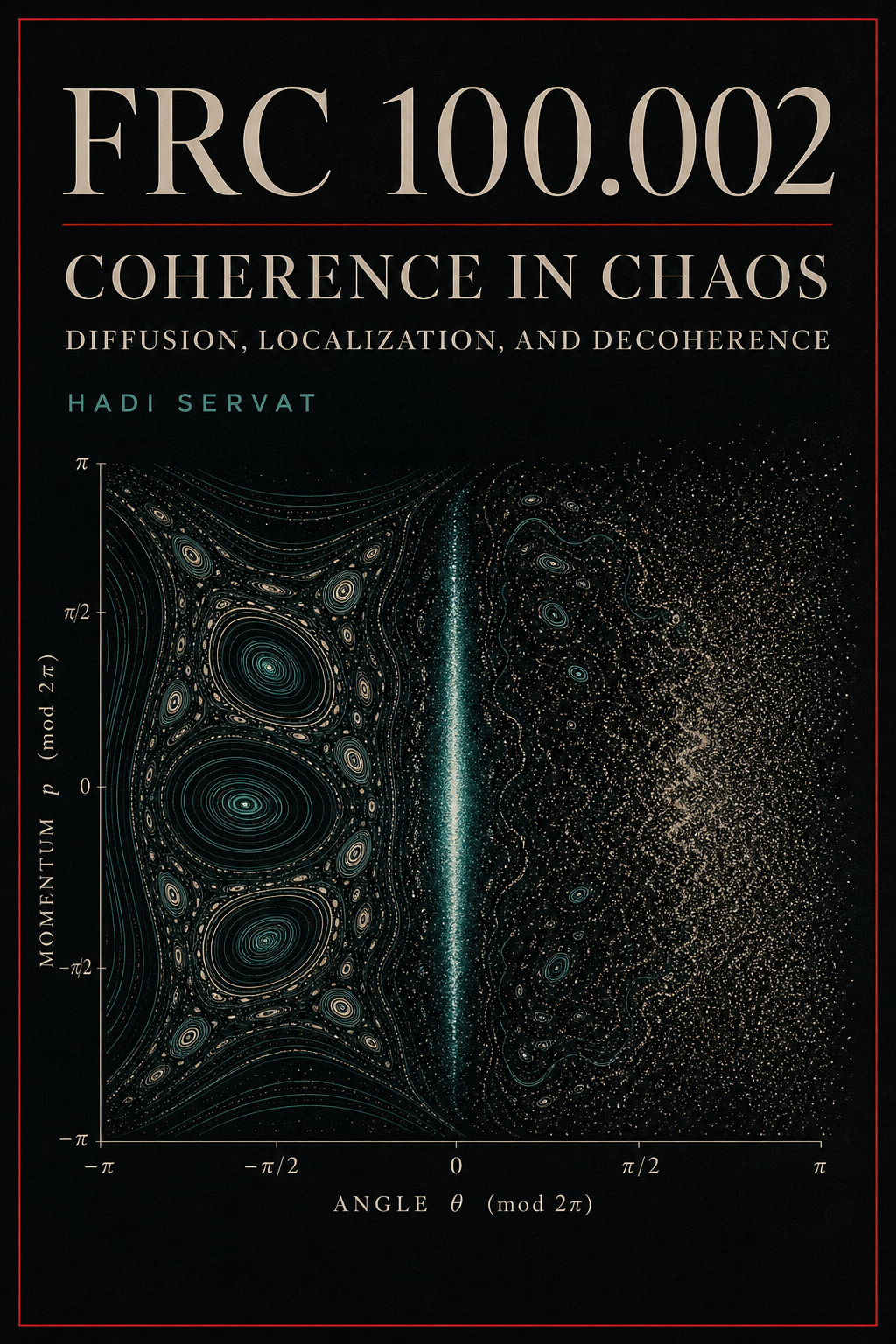
Coherence in Chaos: Diffusion, Localization, and Decoherence in the Standard Map / Quantum Kicked Rotor Family
Reading status
Current statement
100.002 v2: the chaos paper of the basin series, rebuilt on the Standard Map / Quantum Kicked Rotor. Chaos is not the absence of coherence — coherence structure inside chaos is measurable against exact, pre-existing anchors, and localization/decoherence are one ledger read in three regimes. Pilot results included; kills included; stadium demoted to appendix.
Evidence level
Pilot-supported program
preprint
Declared μ register
μ1 · Physical / atomic
Atoms, fields, quantum systems, thermodynamics, and other physical observables.
Open boundary
KAM correspondence, crossover tolerance, and out-of-sample mechanism collapse remain open.
Version lineage
Supersedes: FRC 100.002 v2.5
On this page
FRC 100.002 v2.6 preserves the Standard Map / Quantum Kicked Rotor chaos program, the KAM-structure functional, localization/decoherence pilots, the Ruelle-Pollicott negative result, and the demoted stadium appendix. It records the completed registered dense classical Gate 4 test as a negative result: fine KAM-area tracking fails, while the earlier coarse zero-parameter magnitude correspondence survives in its scoped form. This route does not promote the paper as a pillar. The canonical reciprocity law remains dS + k* d ln C = 0. In this paper's declared information-nat realization k*_{mu_nat}=1, and J_sys=d[S_sys,mu+k*_{mu_nat} ln C_mu]/dt remains a system-only diagnostic, not automatically entropy production or a boundary residual.
Linked from
- Fractal Resonance Coherence: A Framework for Complex Systems Analysis
- Quantum Foundations in the FRC Framework
- The Emergence of the Born Rule from Resonant Equilibrium
- Foundational Questions in Fractal Resonance Coherence
- FRC 700.777 v1.0 - μ Registers: A Nested Scope Model for Scale-Declared Reciprocity
- Accessible Phase-Space Geometry Predicts the Structure Functional in the Mixed Standard Map
- The Ghost in the Machine: An Investigation into Fractal Resonance