

Lambda-Flight v1.2: Operational and Latent Coherence Transport Models
Reading status
Current statement
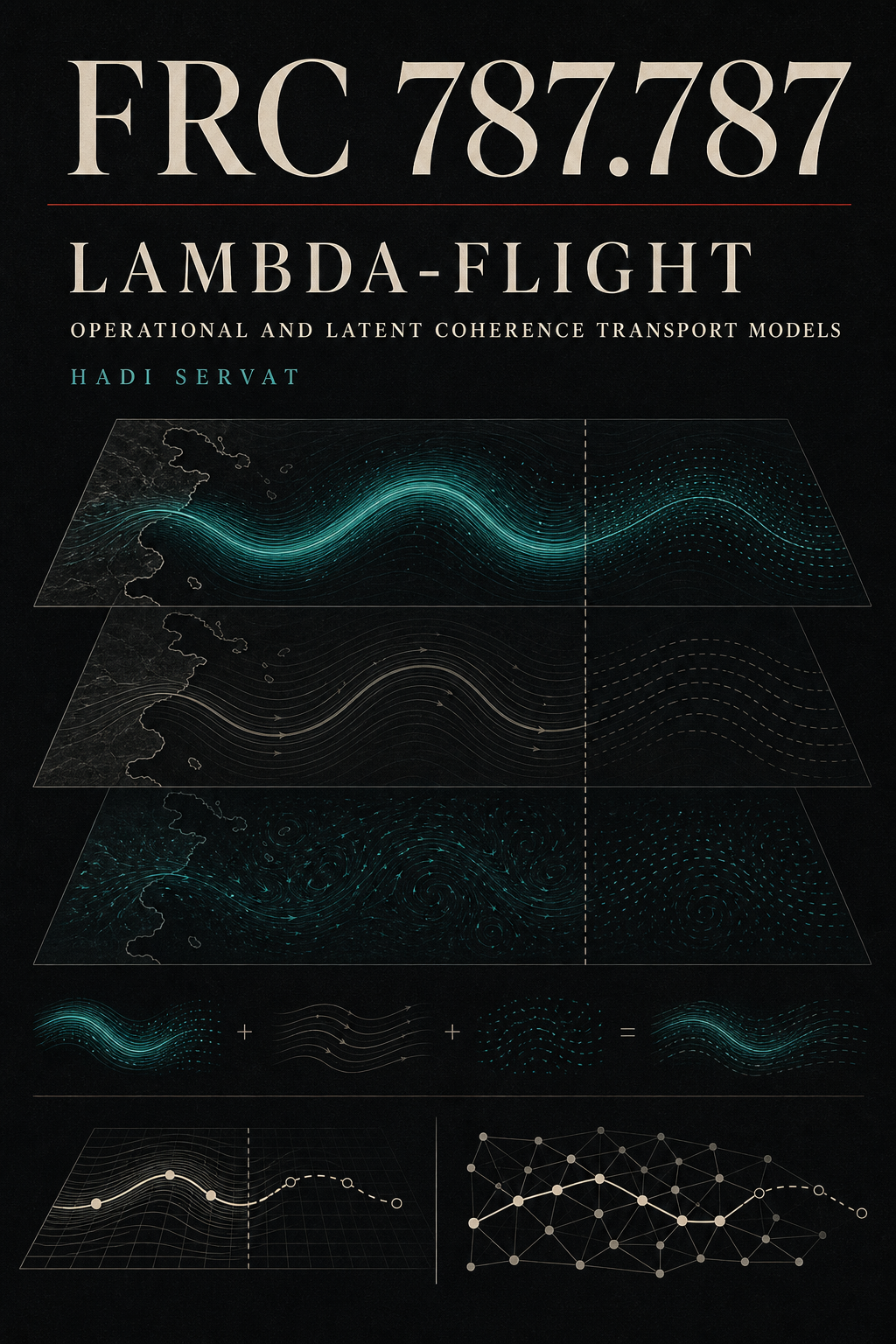
FRC 787.787 v1.2 separates three objects previously called Lambda. Lambda_obs=Lambda0 ln C_obs is an operational transform of preregistered observables; Lambda_eq is an observation-derived target; Lambda_dyn is an optional latent reaction-diffusion state that relaxes toward that target. A transport model must select Lambda_obs or separately validated Lambda_dyn before scoring. Support for Lambda_dyn requires improvement over the observation-only model and an equal-feature non-Lambda latent baseline. Even successful residual prediction would not establish a fundamental field. The nested baselines, negative controls, six test cards, and numerical regime pilot are retained. Version 1.2 adds a locally frozen secondary-data test of P3 on a public Rijke-tube benchmark. The composite is not promoted on that benchmark: its negative held-out point estimate is accompanied by low power, a class/protocol confound, and an imperfect equal-information control. The external test concerns predictive early warning only and does not test entropy-coherence reciprocity.
Evidence level
Pilot-supported program
preprint
Declared μ register
μ4 · Logical / conceptual
Logic, formal models, language as explicit reasoning, and computational design.
Open boundary
Independent platform validation and wins over equal-feature baselines remain required.
Version lineage
Supersedes: FRC 787.787 v1.1 (DOI 10.5281/zenodo.21298185)
On this page
FRC 787.787 v1.2 separates three objects previously called Lambda. Lambda_obs=Lambda0 ln C_obs is an operational transform of preregistered observables; Lambda_eq is an observation-derived target; Lambda_dyn is an optional latent reaction-diffusion state that relaxes toward that target. A transport model must select Lambda_obs or separately validated Lambda_dyn before scoring. Support for Lambda_dyn requires improvement over the observation-only model and an equal-feature non-Lambda latent baseline. Even successful residual prediction would not establish a fundamental field. The nested baselines, negative controls, six test cards, and numerical regime pilot are retained. Version 1.2 adds a locally frozen secondary-data test of P3 on a public Rijke-tube benchmark. The composite is not promoted on that benchmark: its negative held-out point estimate is accompanied by low power, a class/protocol confound, and an imperfect equal-information control. The external test concerns predictive early warning only and does not test entropy-coherence reciprocity.
Linked from
- FRC 100.011 v1.2 - Translation Table: FRC Vocabulary and Claim Status
- Accessible Phase-Space Geometry Predicts the Structure Functional in the Mixed Standard Map
- The Reflexive Threshold: Corpus Integration, Witness, and Claim-Graph Audit v0.1
- The FRC Threshold Handbook: A Standalone Onboarding and Application Protocol v0.1